Module 1
Scorecard
DeuceGC, Montclair Sports LLC · Case study
Evolving a broad golf app into a focused player-development system that helps serious golfers plan practice, log structured sessions, review evidence, and decide what to work on next.
Current product direction: a player-development system organized around planning focused work, practicing deliberately, reviewing progress, and returning to the next session with a clearer decision.
Scope
Labels
Summary
Problem
Golfers can collect round and practice data without a clear bridge to what they should practice next.
Approach
I narrowed DeuceGC from a broad golf product into a Plan -> Practice -> Improve -> Perform loop, while keeping Coach/NCAA pilot work and GPS/Terrain as controlled expansion surfaces.
Outcome
The product matured into a shipped web system with practice capture, scheduling, sessions and review, pricing and entitlements, analytics contracts, launch-readiness guardrails, Coach pilot surfaces, and incoming GPS/Terrain support.
Guided Flow
The core walkthrough follows one serious golfer from a practice priority into a drill, a live session, and a review state that points back to the next action.
Problem
The useful design problem became clearer as the product moved from broad golf tracking toward next-practice decision support.
Git history
The original October 2025 implementation grouped a dashboard, course planner, round analyzer, and putting practice. The breadth was credible, but the product did not yet have a single improvement spine.
Research synthesis
Short-game research and category review suggested a gap between emotionally memorable misses, diagnostic evidence, and the next practice session.
Strategy docs
A May 2026 lean-canvas pass framed the product risk as expectation sprawl across rounds, practice, coaching, range, pricing, and recommendations.
Constraints
Setup, live logging, and review had to work for golfers at a putting green, short-game area, range bay, or post-round moment - not only in a desktop analytics session.
The system can use recommendation scaffolding, but the public case study avoids unproven improvement claims and keeps the focus on evidence, review, and next-action clarity.
Coach is an upcoming pilot surface for team and NCAA workflows, while the near-term product focus remains getting the Core tier into more golfers' hands.
Terrain is the incoming GPS layer for spatial practice and range/course context. The story can name it without claiming validated GPS reliability or usage outcomes.
AI tools, MCPs, custom skills, and prompt engineering accelerated execution, but the hardest product decision was still what not to make central.
Principles
01
The experience should answer 'what should I practice next?' before asking a golfer to interpret charts or configure a complex tracking setup.
02
Practice screens prioritize fast session start, make/miss capture, and review over dense analysis during the session itself.
03
Coach/NCAA and GPS/Terrain show system ambition, but the main case-study story stays anchored on the Core practice loop and its evidence model.
Exploration
The case study arc is product narrowing. DeuceGC moved through several defensible states before the practice-loop thesis became the clearest public story.
Direction A
Direction B
Direction C
Decision
| Option | Practice clarity | Portfolio credibility | Evidence support |
|---|---|---|---|
| All-in-one golf app | Medium | Low | High for the original state |
| GPS/Terrain layer | Medium | Medium | Useful as incoming feature, not main thesis |
| Practice-loop player-development system | High | High | High |
Recommendation
Lead with the practice-loop player-development thesis. It is the clearest design story and the best-supported product arc in the codebase history.
Outcome
The verified outcome is product-system maturity and a clearer strategic spine, not a public claim of quantified business impact.
Git history shows the move from dashboard/planner/analyzer breadth into a practice-loop thesis.
Plan, Practice, Improve, and Perform now organize the product promise.
PostHog, Stripe, and private customer-feedback claims are intentionally excluded.
DeuceGC now has a shipped production presence, a focused public promise, implemented practice and review flows, commercial access infrastructure, analytics contracts, design-system documentation, a shareable Figma source-of-truth starter file, and launch-readiness standards. The honest next chapter is validation: Core tier adoption, Coach pilot learning, and Terrain/GPS reliability all need evidence before they become outcome claims.
Reflection
The senior-design signal in this work is judgment under ambiguity: narrowing a founder-led product from many plausible golf surfaces into a coherent loop, while naming where evidence ends and future validation begins. The tempting move was to make the product feel bigger. The better move was to make the next practice decision clearer.
Available
Best fit for platform UX, growth systems, internal tools, and teams that need a senior IC who can shape the problem and ship the details. I respond to most inbound within a day.
DeuceGC practice loop
Plan
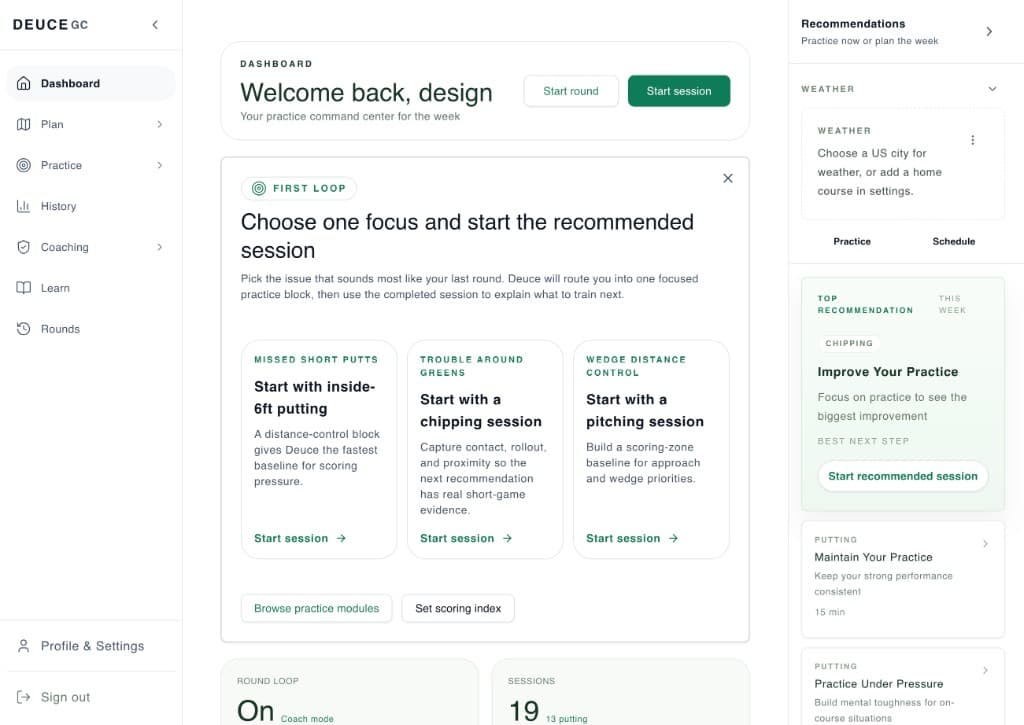
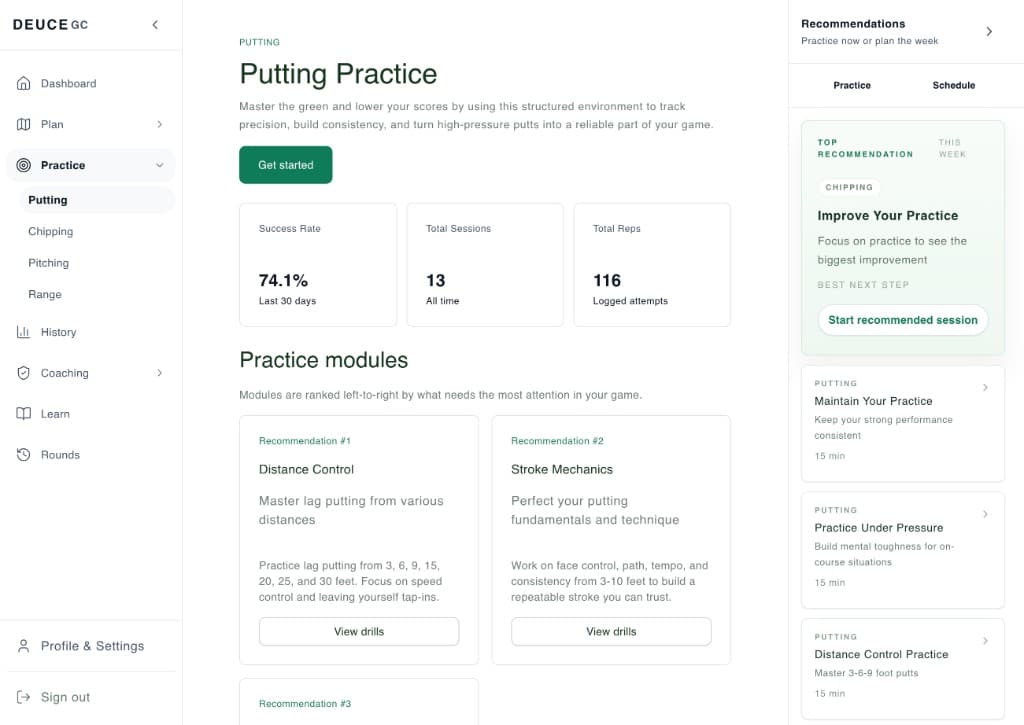
The dashboard First Loop and putting hub route golfers from intent to a ranked module without asking them to configure the whole app first.
Direction A - all-in-one app
First session
Module 1
Scorecard
Module 2
Rounds
Module 3
Range map
Module 4
Equipment
Module 5
Stats
Module 6
Calendar
Module 7
Coach
Module 8
Settings
Direction B - stats tracker
Session review
Sessions
Short game
6
Best signal
Inside zone
74%
Miss trend
Long bias
+12%
Direction C - practice loop
Focus
24 reps from 15-25 yards
Active session
Inside zone
Control
75%
Miss pattern
Long
+12%
Next block
Repeat ladder
15 min
Practice loop
Dashboard First Loop routes golfers into a focused practice block
Before — broad golf app
First session
Scorecard
Rounds
Range map
Stats
Equipment
Coaching
Product risk
Breadth looks complete, but the golfer still has to choose a job before logging a useful practice signal.